


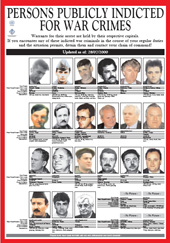
The issue of fugitives and how to ensure that they are brought to justice has been one of the Tribunal's greatest challenges throughout much of its existence. In the ICTY’s early years, the large number of fugitives compared to the small number of persons in custody, threatened to undermine much of the Tribunal’s work.
However, despite years of recurring difficulties, July 2011 saw an important achievement: the arrest of the Tribunal’s last remaining fugitive. Goran Hadžić, former president of the self-proclaimed Republic of Serbian Krajina was indicted by the ICTY’s Office of the Prosecutor (OTP) in 2004 and had been on the run ever since. He was charged with war crimes and crimes against humanity allegedly committed in eastern Slavonia, Croatia, between 1991 and 1993.
The arrest of Hadžić meant that none of the 161 people indicted by the Tribunal had managed to escape justice. Serge Brammertz, Prosecutor of the ICTY, said, “In 1993, the hurdles to arresting and trying most of the individuals wanted by the Tribunal seemed impossible to overcome… For the Tribunal – and for international justice – the arrest of Goran Hadžić is a milestone to remember."
Hadžić’s arrest came less than two months after the apprehension of Ratko Mladić, Colonel General and former Commander of the Main Staff of the Bosnian Serb Army. Mladić was indicted by the OTP on 25 July 1995 for genocide, crimes against humanity and war crimes committed in Bosnia and Herzegovina between 1992 and 1995. He had spent almost 16 years as a fugitive from justice.
In July 2011, eighteen years after the Tribunal’s inception, it was finally possible to say that no indicted person had successfully evaded the Tribunal’s judicial process. This is a precedent of enduring significance - for the victims of the crimes committed during the wars in the former Yugoslavia, for the Tribunal, and for international criminal justice in general.
Making the arrests
The Tribunal has no police force and no capacity to arrest anyone. The Tribunal had to rely on states to make arrests. Pursuant to Security Council resolutions and the Tribunal’s Statute, UN member states are obliged to cooperate with the Tribunal unconditionally and to comply with its requests for assistance and its orders. However, for many years, little was done to arrest the Tribunal's fugitives, and on many occasions the Tribunal’s Presidents and Prosecutors reported to the Security Council on the lack of cooperation of the states of the former Yugoslavia.
To help in the search for the fugitives, the Office of the Prosecutor set up a small tracking team tasked with collecting information on their whereabouts. But the Tribunal nevertheless remained reliant on the cooperation of national governments and international forces based in Bosnia and Herzegovina to conduct searches and make arrests.
The early years
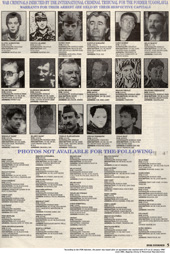
In its formative years the Tribunal faced serious obstacles in securing the arrest and transfer of fugitives. states such as the Federal Republic of Yugoslavia (Serbia and Montenegro) and the Republika Srpska entity of Bosnia and Herzegovina, as well as the Republic of Croatia, refused to search for, detain or transfer persons indicted to stand trial in The Hague. Indeed, in many instances the authorities provided fugitives with protection from arrest and generally exhibited contempt for the Tribunal’s orders.
On a number of occasions the international troops stationed in Bosnia and Herzegovina failed to take action to arrest the accused persons. By mid-1997 more than 50 fugitives were at large – mostly in Serbia and in Republika Srpska - and only eight suspects were in custody in The Hague.
The situation improves
The situation improved in late-1996, when the Prosecutor introduced sealed indictments. The names of the individuals against whom these indictments were raised were kept confidential until the moment of their arrest. Additionally, from mid-1997 onwards, the preparedness of multi-national peacekeeping forces such as SFOR (the Stabilisation Force in Bosnia and Herzegovina) to arrest suspects significantly increased the number of indicted individuals transferred to The Hague to stand trial.
Such arrests also prompted many fugitives to surrender voluntarily rather than be subject to arrest by military forces. Around 2000, changed political circumstances in Serbia and Croatia meant that cooperation regarding the arrest of fugitives started to improve. The arrest and transfer of former Yugoslav president Slobodan Milošević in June 2001 was a significant development.
From 2004 until 2005, a blend of shifting political circumstances in the region and persistent pressure from the international community led to numerous voluntary surrenders and arrests. The improved political will to cooperate with the Tribunal from authorities in the former Yugoslavia resulted from the substantial pressure of the international community and the decision to make full cooperation with the Tribunal a pre-condition for opening accession talks with the European Union.
100% success rates
The July 2008 arrest of Radovan Karadžić -war-time political leader of the Bosnian Serbs, charged with genocide, complicity in genocide, extermination, murder, willful killing, persecutions, deportations, inhumane acts and other crimes committed against the non-Serb population in Bosnia and Herzegovina - was the result of a successful operation conducted by the Serbian authorities. Karadzic spent almost 13 years as a fugitive. In relation to his arrest, Prosecutor Brammertz stated: “This is a very important day for the victims who have waited for this arrest for over a decade. It is also an important day for international justice because it clearly demonstrates that nobody is beyond the reach of the law and that sooner or later all fugitives will be brought to justice.”
Three years after Karadžić's arrest, Ratko Mladić and Goran Hadžić were arrested and transferred to the Tribunal. Of the 161 persons indicted by the Tribunal, none remain at large.
Transfer of Goran Hadžić, the last ICTY fugitive: Press Conference Video