

The Tribunal's proceedings are underpinned by the presumption of innocence. All suspects indicted by the Prosecution enjoy a presumption of innocence and the burden is on the Prosecution to prove the accused's guilt beyond reasonable doubt. A failure on the part of the Prosecution to do so will result in an acquittal of the accused.
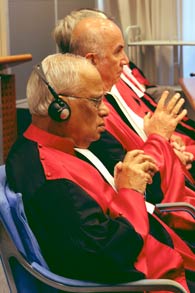
Most of the acquittals at the Tribunal have come about in cases in which the evidence presented by the Prosecution was either insufficient to establish that specific crimes occurred, or insufficient to demonstrate that the accused bore criminal responsibility for the commission of the crime.
The Prosecution bears the onus of establishing the guilt of the accused beyond reasonable doubt. The burden upon the Prosecution to prove guilt beyond reasonable doubt in criminal proceedings is common to most judicial systems of the world and is regarded as a key component of a legal system established in accordance with the rule of law.
In Prosecutor v. Hadžihasanović et al. case, the Appeals Chamber found that the evidence presented by the Prosecution did not demonstrate beyond reasonable doubt that the accused was responsible pursuant to the mode of liability alleged in the indictment:
“[I]n order to demonstrate that Hadžihasanović had effective control over the members of the El Mujahedin detachment, the Prosecution was required to prove beyond reasonable doubt that Hadžihasanović had the material ability to prevent or punish the criminal conduct of its members. Such material ability is a minimum requirement for the recognition of a superior-subordinate relationship for the purposes of Article 7(3) of the Statute. The Appeals Chamber, taking into account the submissions of the Parties, reviewed all of the relevant findings of the Trial Chamber and examined their significance in terms of effective control, both in isolation and collectively. In light of the foregoing, the Appeals Chamber finds that no reasonable trier of fact could have concluded that it was established beyond reasonable doubt that Hadžihasanović had effective control over the El Mujahedin detachment between 13 August and 1 November 1993”. [Appeal Judgement, para. 231]
“[t]he Appeals Chamber does not dispute that the 3rd Corps may have benefited from the El Mujahedin detachment, and that a circumstance of this kind may entail some form of responsibility, if the particulars of such responsibility are adequately pleaded in an Indictment. The Appeals Chamber nevertheless questions the relevance of that consideration for demonstrating the existence of Hadžihasanović’s effective control over the El Mujahedin detachment”. [Appeal Judgement, para. 213]
Further, in Prosecutor v. Limaj et al. case, after a careful review of the evidence presented by the Prosecution, the Trial Chamber observed that:

“[f]or the reasons identified in the preceding paragraphs, the Chamber is not able to be satisfied beyond reasonable doubt that the Prosecution has established that in the period from May to 26 July 1998, the Accused Fatmir Limaj held a position of command in the KLA which included command of KLA soldiers in the village of Llapushnik /Lapusnik or, in particular, in the prison camp which existed at that time in the southern part of that village. That is so whether each relevant piece of evidence is considered separately, or in combination. As has been indicated, even though there is a strong possibility apparent on the evidence that Fatmir Limaj was active as a commander in the prison camp at times relevant to the Indictment, the Chamber’s role and duty remains clear. It is to determine whether the Prosecution has been able to prove its case beyond reasonable doubt in so far as it alleges that Fatmir Limaj exercised command, de jure or de facto, or effective control, in the prison camp and over the KLA soldiers conducting the camp or over the KLA guards who escorted the remaining prisoners from the prison camp to the nearby Berishe /Berisa Mountains on 25 or 26 July 1998. In the finding of the Chamber, on very careful final analysis, the evidence falls short of establishing these essential matters to the required degree, which is beyond reasonable doubt”. [Trial Judgement, para. 601]
This finding was later upheld by the Appeals Chamber.
Analogously, the Appeal Judgement in the Prosecutor v. Orić case held that:
“[l]ike the Trial Chamber, the Appeals Chamber has no doubt that grave crimes were committed against Serbs detained at the Srebrenica Police Station and the Building between September 1992 and March 1993. The Defence did not challenge that crimes were committed against Serb detainees. However, proof that crimes have occurred is not sufficient to sustain a conviction of an individual. Criminal proceedings require evidence establishing beyond reasonable doubt that the accused is responsible for the crimes before a conviction can be entered. Where an accused is charged with command responsibility pursuant to Article 7(3) of the Statute, as in the present case, the Prosecution must prove, inter alia, that his subordinate(s) bore criminal responsibility and that he knew or had reason to know of his/their criminal conduct”. [Appeal Judgement, para. 189]
In some instances, the evidence presented by the Prosecution was sufficient to establish the guilt of the accused for some of the charges alleged in the indictment but not for others. In such cases, acquittals were entered on certain specific counts.
In the case of Prosecutor v. Jelisić, for example, the Trial Chamber sentenced the Accused for the counts to which he had pled guilty and acquitted him for the crime of genocide. While the The Trial Chamber was satisfied that persons belonging to a ethnic group had been murdered, it was not satisfied that the accused participated in those murders with genocidal intent. The Trial Chamber observed that:
“[i]t has not been proved beyond all reasonable doubt that the accused was motivated by the dolus specialis of the crime of genocide. The benefit of the doubt must always go to the accused and, consequently, Goran Jelisic must be found not guilty on this count”. [Trial Judgement, para. 108]
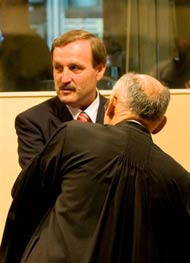
Similarly, in the Prosecutor v. Martić case, the Trial Chamber acquitted the accused for the crime of persecution, observing that:
“Martić considered the shelling of Croatian cities as a response to Croatian attacks on RSK cities. However, the Trial Chamber has not found any evidence which would persuade it beyond reasonable doubt that Milan Martić intended to commit such attacks (…) with discriminatory intent on the basis of ethnicity. (…) While an attack on a city, such as in this case, is without doubt grave, the Trial Chamber cannot find that it establishes in and of itself that it was carried out with the requisite intent. The Trial Chamber therefore concludes that the elements of the crime of persecution (…) have not been established”.
[Trial Judgement, para. 473]
Adherence to the rule of law and fair trial principles is the bedrock of the Tribunal’s Statute and jurisprudence. When the Prosecution fails to support the allegations contained in the indictment with credible and reliable evidence demonstrating the accused’s criminal responsibility beyond any reasonable doubt, judgements of acquittal must be pronounced.*
* All the above cited cases are examples only.
|
2013 |
||||
|
Date |
Accused Name |
Case Name |
Case Number |
Type of Judgement (searchable PDF) |
| 28 February 2013 | Momčilo Perišić | Perišić | IT-04-81 | Appeals Chamber |
|
2012 |
||||
|
Date |
Accused Name |
Case Name |
Case Number |
Type of Judgement (searchable PDF) |
| 29 November 2012 | Ramush Haradinaj | Haradinaj et al. | IT-04-84 bis T | Trial Chamber (retrial) |
| 29 November 2012 | Idriz Balaj | Haradinaj et al. | IT-04-84 bis T | Trial Chamber (retrial) |
| 29 November 2012 | Lahi Brahimaj | Haradinaj et al. | IT-04-84 bis T | Trial Chamber (retrial) |
| 16 November 2012 | Ante Gotovina | Gotovina et al. | IT-06-90 | Appeals Chamber |
| 16 November 2012 | Mladen Makač | Gotovina et al. | IT-06-90 | Appeals Chamber |
|
2011 |
||||
|
Date |
Accused Name |
Case Name |
Case Number |
Type of Judgement (searchable PDF) |
| 15 April 2011 | Ivan Čermak | Gotovina et al. | IT-06-90 | Trial Chamber |
|
2010 |
||||
|
Date |
Accused Name |
Case Name |
Case Number |
Type of Judgement (searchable PDF) |
| 19 May 2010 | Ljube Boškoski | Boškoski and Tarčulovski | IT-04-82 | Appeals Chamber |
|
2009 |
||||
|
Date |
Accused Name |
Case Name |
Case Number |
Type of Judgement (searchable PDF) |
| 26 February 2009 | Milan Milutinović | Milutinović et al. | IT-05-87 | Trial Chamber |
|
2008 |
||||
|
Date |
Accused Name |
Case Name |
Case Number |
Type of Judgement (searchable PDF) |
| 3 July 2008 | Naser Orić | Naser Orić | IT-03-68 | Appeals Chamber |
|
2007 |
||||
|
Date |
Accused Name |
Case Name |
Case Number |
Type of Judgement (searchable PDF) |
| 16 October 2007 | Sefer Halilović | Sefer Halilović | IT-01-48 | Appeals Chamber |
| 27 September 2007 | Miroslav Radić | Mrkšić et al. | IT-95-13/1 | Trial Chamber |
| 27 September 2007 | Fatmir Limaj | Limaj et al. | IT-03-66 | Appeals Chamber |
| 27 September 2007 | Isak Musliu | Limaj et al. | IT-03-66 | Appeals Chamber |
|
2001 |
||||
|
Date |
Accused Name |
Case Name |
Case Number |
Type of Judgement (searchable PDF) |
| 23 October 2001 | Zoran Kupreškić | Kupreškić et al. | IT-95-16 | Appeals Chamber |
| 23 October 2001 | Mirjan Kupreškić | Kupreškić et al. | IT-95-16 | Appeals Chamber |
| 23 October 2001 | Vlatko Kupreškić | Kupreškić et al. | IT-95-16 | Appeals Chamber |
| 20 February 2001 | Zejnil Delalić | Mucić et al. | IT-96-21 | Appeals Chamber |
|
2000 |
||||
|
Date |
Accused Name |
Case Name |
Case Number |
Type of Judgement (searchable PDF) |
| 14 January 2000 | Dragan Papić | Kupreškić et al. | IT-95-16 | Trial Chamber |
* Cases in which an appeal is pending following a first instance judgement are not included in this table.