

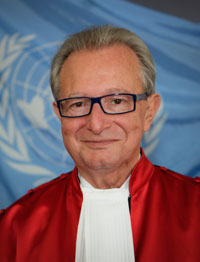
Judge Carmel Agius (Malta)
President of the ICTY from 2015 to 2017
Born: 18 August 1945, Malta
Judge Carmel Agius is the Tribunal’s current President, elected to this position by his fellow Judges on 21 October 2015. He served as Vice-President from 2011 through 2015 and is also an Appeals Chamber judge of both the Tribunal and the ICTR. He was first elected to the Tribunal in 2001 and re-elected in 2004. Between 2003 and 2010, he was Presiding Judge of Trial Chamber II of the Tribunal during which time he presided over the Brđanin, the Orić and the multi-accused Popović trials. He was also engaged in the initial appearance and pre-trial preparation and disposal of several other cases.
Since 2010, he has been dealing with appeals from both the Tribunal and the ICTR. Presently, he is presiding over multiple appeal matters. Since 2003 he has chaired the Rules Committee of the Tribunal and has served as a member of the Tribunal’s Bureau. In 2010 and 2011, on behalf of the Tribunal he has coordinated and brought to a conclusion the drafting of the Rules of Procedure and Evidence of the Mechanism for International Criminal Tribunals which were submitted to and accepted by the UN Security Council, and later adopted by the judges of the Mechanism. In 2011 he was elected a Judge of the Mechanism.
Prior to being elected to the Tribunal, Judge Agius was a Senior Judge in the Court of Appeal of Malta and the Constitutional Court of Malta, and was Acting Chief Justice on several occasions. Between 1999 and 2008, Judge Agius was a Member of the Permanent Court of Arbitration. From 1990 and 2001, he was Head of the Maltese Delegation at all annual meetings of the United Nations Commission on Crime Prevention and Criminal Justice in Vienna. He also represented the Maltese Government at the 7th, 8th, 9th and 10th United Nations Congresses on Crime Prevention and the Treatment of Offenders.
Between 1996 and 1998, Judge Agius represented the Government of Malta at the meetings of the United Nations Preparatory Committee on the proposed Permanent International Criminal Court. In 1998, he was Acting Head of Delegation and Adviser of the Government of Malta at the United Nations Plenipotentiary Conference on the International Criminal Court, Rome where he was actively involved in the negotiations and signed the Final Document on behalf of Malta. Later, he represented his country during the work of the Preparatory Commission for the International Criminal Court which drew up the Rules of Evidence and Procedure and the Definitions of Crimes for the ICC.
From 1996 to 1999, he was Pro-Chancellor of the University of Malta, and between 1998 and 2004, he was a member of the Editorial Board of the Mediterranean Journal of Human Rights published by the Foundation for International Studies and the Faculty of Law of the University of Malta. Between 1989 and 2001, Judge Agius was the representative of the Maltese Judiciary on the Central Council of the International Association of Judges.
Judge Theodor Meron (USA)
President of the ICTY from 2011 to 2015
and from 2003 to 2005
Born: 28 April 1930, Kalisz, Poland
Judge Theodor Meron served four terms as President of the Tribunal. He was first elected as President of the ICTY on 27 February 2003 and reelected on 17 November 2003. He served another two consecutive terms as President of the Tribunal between 17 November 2011 and 16 November 2015.
Judge Meron is currently serving as President of the Mechanism for International Criminal Tribunals (Mechanism), a position to which he was first appointed by the United Nations Secretary-General effective 1 March 2012. He was appointed to a new term as President of the Mechanism effective 1 March 2016.
Since his election as a Judge of the ICTY by the U.N. General Assembly in March 2001, Judge Meron, a citizen of the United States, has served on the Appeals Chambers of both the ICTY and the International Criminal Tribunal for Rwanda (ICTR). A leading scholar of international humanitarian law, human rights, and international criminal law, Judge Meron wrote some of the books and articles that helped build the legal foundations for international criminal tribunals, and he has contributed to the development of international law, and especially international humanitarian and criminal law, in a variety of fora. A Shakespeare enthusiast, he has also written articles and books on the laws of war and chivalry in Shakespeare’s historical plays.
Judge Meron received his legal education at the Universities of Jerusalem, Harvard (where he received his doctorate), and Cambridge. He immigrated to the United States in 1978. He immigrated to the United States in 1978. Prior to his immigration to the United States, he was legal adviser of the Israeli Ministry of Foreign Affairs, Ambassador to Canada, and Permanent Representative to the United Nations in Geneva. In 1978, he became a Professor of International Law and, in 1994, he was appointed the Charles L. Denison Chair at New York University School of Law. Between 1991 and 1995 he was also Professor of International Law at the Graduate Institute of International and Development Studies in Geneva, and he has been a Visiting Professor of Law at Harvard University and at the University of California (Berkeley). In 2006, he was named Charles L. Denison Professor Emeritus and Judicial Fellow at New York University School of Law.
In 1990, Judge Meron served as a Public Member of the U.S. Delegation to the Commission on Security and Cooperation in Europe (CSCE) Conference on Human Dimensions in Copenhagen. In 1998, he served as a member of the U.S. Delegation to the Rome Conference on the Establishment of an International Criminal Court (ICC), where he was involved in the drafting of the provisions on crimes, including war crimes and crimes against humanity. He has also served on the Preparatory Commission for the Establishment of the ICC, with particular responsibilities for the definition of the crime of aggression. He has acted as counsel for the United States before the International Court of Justice, and in 2000-2001 served as Counselor on International Law in the U.S. Department of State.
Judge Meron has also served on several committees of experts of the International Committee of the Red Cross (ICRC), including those on Internal Strife, on the Environment and Armed Conflicts, and on Direct Participation in Hostilities under International Humanitarian Law. In addition, he was a member of the steering committee of ICRC experts on Customary Rules of International Humanitarian Law. He has also served on the advisory committees or boards of several human rights organizations, including Americas Watch and the International League for Human Rights, and was a member of the “Panel of Eminent Persons within the Swiss Initiative to commemorate the 60th anniversary of the Universal Declaration of Human Rights,” which concerned a future agenda for human rights.
Judge Meron was Co-Editor-in-Chief of the American Journal of International Law (1993-98) and is now an honorary editor. He is a member of the Institute of International Law, the Board of Editors of the Yearbook of International Humanitarian Law, the Council on Foreign Relations, the French Society of International Law, the American Branch of the International Law Association, and the Bar of the State of New York. He is also a Fellow of the American Academy of Arts and Sciences. Judge Meron is a patron and a past Honorary President of the American Society of International Law.
Judge Meron has been a Carnegie Lecturer at The Hague Academy of International Law, Fellow of the Rockefeller Foundation, Max Planck Institute Fellow (Heidelberg), Sir Hersch Lauterpacht Memorial Lecturer at the University of Cambridge, and Visiting Fellow at All Souls College, Oxford. Judge Meron delivered the 2003 General Course of Public International Law at The Hague Academy of International Law. He was also the Marek Nowicki Lecturer for 2008 lectures in Budapest and Warsaw under the auspices of the Open Society Institute, and delivered the 2014 Oxford Annual Lecture on Global Justice. He has lectured at many universities and at the International Institute of Human Rights (Strasbourg). In addition, Judge Meron helped establish the ICRC/Graduate Institute of International and Development Studies seminars for University Professors on International Humanitarian Law. He is a frequent lecturer at ICRC seminars, and he founded and continues to lead the annual ICRC seminars for U.N. diplomats on international humanitarian law at New York University, a tradition spanning three decades.
Since 2014, Judge Meron has been a visiting professor of international criminal law at the University of Oxford. He donates his Oxford salary to the University, which has enabled the establishment of an internship fund for Oxford students at the Mechanism.
Judge Meron was awarded the 2005 Rule of Law Award by the International Bar Association and the 2006 Manley O. Hudson Medal of the American Society of International Law. He was made Officer of the Legion of Honor by the President of France in 2007, and in 2013, Grand Officer of the National Order of Merit. He received the Charles Homer Haskins Prize of the American Council of Learned Societies for 2008. In 2009 he was elected Fellow of the American Academy of Arts and Sciences. In 2011 he received a doctorate honoris causa from the University of Warsaw.
A frequent contributor to the American Journal of International Law and other legal journals, Judge Meron is the author of more than 100 articles in legal publications. His books are: Investment Insurance in International Law (Oceana-Sijthoff 1976); The United Nations Secretariat (Lexington Books 1977); Human Rights in International Law (Oxford University Press 1984); Human Rights Law-Making in the United Nations (Oxford University Press 1986) (awarded the certificate of merit of the American Society of International Law); Human Rights in Internal Strife: Their International Protection (Sir Hersch Lauterpacht Memorial Lectures, Grotius Publications 1987); Human Rights and Humanitarian Norms as Customary Law (Oxford University Press 1989); Henry’s Wars and Shakespeare’s Laws (Oxford University Press 1993); Bloody Constraint: War and Chivalry in Shakespeare (Oxford University Press 1998); War Crimes Law Comes of Age: Essays (Oxford University Press 1998); International Law In the Age of Human Rights (Martinus Nijhoff 2004); The Humanization of International Law (Martinus Nijhoff 2006); and The Making of International Criminal Justice: The View from the Bench: Selected Speeches (Oxford University Press 2011). He is also among the editors of Humanizing the Laws of War: Selected Writings of Richard Baxter (Oxford University Press 2013).
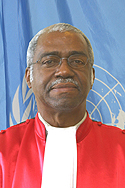
Judge Patrick Lipton Robinson (Jamaica)
President of the ICTY from 2008 to 2011
Born: 1944, Jamaica
Judge Patrick Lipton Robinson of Jamaica served as the Tribunal’s President between November 2008 and November 2011. He was first elected as a judge of the Tribunal by the UN General Assembly on 16 October 1998, and is currently presiding the Appeals Chamber in the Popović et al. case. Prior to his duties as President, Judge Robinson served in Trial Chamber III, where he presided over numerous cases, including those of Slobodan Milošević and Dragomir Milošević. He also presided the ICTY Appeals Chamber in the cases of Boškoski and Tarculovski, and of Haradinaj et al. In addition, he was assigned to sit on the Appeals Chamber in several cases, including the Appeals Chamber of the International Criminal Tribunal for Rwanda.
A graduate teacher of English from 1964 to 1966, Judge Robinson went on to begin a long and distinguished career in public service, working for the Jamaican government during three decades. From 1968 to 1971, he served as a Crown Counsel in the Office of the Director of the Public Prosecutions. Between 1972 and 1998, he served briefly as Legal Adviser to the Ministry of Foreign Affairs, and subsequently in the Attorney General’s Department as Crown Counsel, Senior Assistant Attorney-General, Director of the Division of International Law, and Deputy Solicitor-General.
Judge Robinson’s long-standing experience in UN affairs dates back to 1972, when he became Jamaica’s Representative to the Sixth (Legal) Committee of the United Nations General Assembly, a position that he held for 26 years. He played a leadership role on several items in the Committee, including the definition of aggression and the draft statute for an international criminal court. From 1981 to 1998, he led Jamaica’s delegations for the negotiation of treaties on several subjects, including extradition, mutual legal assistance, maritime delimitation and investment promotion and protection.
Judge Robinson has been a member of numerous international bodies. As a member of the Inter-American Commission on Human Rights from 1988 to 1995, and its Chairman in 1991, he contributed to the development of a corpus of human rights laws for the Inter-American System. As a member of the International Law Commission from 1991 to 1996, he served on the Working Group that elaborated the draft statute for an international criminal court. Judge Robinson also served as a member of the Haiti Truth and Justice Commission from 1995 to 1996, was a member of the International Bio-ethics Committee of UNESCO from 1996 to 2005, serving as its Vice-Chairman from 2002 to 2005, and represented Jamaica at the United Nations Commission on Transnational Corporations (UNCTAD), serving as its Chairman at its 12th Session in 1986. He represented Jamaica at all sessions of the Third United Nations Conference on the Law of the Sea and was accredited as an ambassador to that conference in 1982.
Judge Robinson is a Barrister of Law, Middle Temple, United Kingdom. He holds a B.A. in English, Latin, and Economics from University College of the West Indies (London), an LLB with honours from London University, and an LL.M. in International Law from King’s College, University of London, in the areas of the Law of the Sea, the Law of the Air, Treaties, and Armed Conflict. He also holds a Certificate of International Law from The Hague Academy of International Law.
Judge Fausto Pocar (Italy)
President of the ICTY from 2005 to 2008
Born: 1939, Milan, Italy
Italian law professor Fausto Pocar was the Tribunal’s President between November 2005 and November 2008. He had previously served as the Vice-President between March 2003 and November 2005. Judge Pocar has been a Tribunal judge since 1 February 2000.
Judge Pocar is Professor of International Law at the Law Faculty of the University of Milan, where he has also served as the Dean of the Faculty of Political Sciences and as the Vice-Rector. He is the author of numerous publications on International Law, including Human Rights and Humanitarian Law, Private International Law and European Law. He has lectured at The Hague Academy of International Law. He is a member of the board of the Institute of International Law and Vice-President of San Remo’s Institute of International Humanitarian Law, as well as a member of several other international law associations.
Judge Pocar has a long standing experience in UN activities, in particular in the field of human rights and humanitarian law. He has served for 16 years (1984-2000) as a member of the Human Rights Committee under the International Covenant on Civil and Political Rights and has been its Chairman (1991-92) and Rapporteur (1989-90). Further, he was appointed Special Representative of the UN High Commissioner for Human Rights for visits to Chechnya and the Russian Federation during the 1995-6 conflict.
He has also chaired the informal working group that drafted, within the Commission on Human Rights, the Declaration on the rights of people belonging to national or ethnic, religious or linguistic minorities, that was adopted in 1992 by the General Assembly. He has also been for a decade the Italian delegate to the Committee on the Peaceful Uses of Outer Space and its Legal Subcommittee.
Since his appointment to the ICTY, Judge Pocar has served as a Judge in a Trial Chamber, where he sat on the first case concerned with rape as a crime against humanity, and in the Appeals Chamber of the Tribunal, where he is still sitting. As a Judge of the Appeals Chamber, he is also a Judge of the Appeals Chamber of the International Criminal Tribunal for Rwanda (ICTR). On appeal, he has participated in the adoption of the final judgments in several ICTY and ICTR cases, heard both at The Hague and in Arusha, Tanzania.
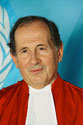
Judge Claude Jorda (France)
President of the ICTY from 1999 to 2003
Born: 1938, Bône, Algeria
Judge Claude Jorda of France served as the Tribunal’s President between November 1999 and February 2003. During his term in office, Judge Jorda initiated significant reforms towards a more efficient judicial process and contributed to plans for the Tribunal’s completion strategy.
Originally appointed a Tribunal judge in January 1994, he played an important role in the establishment and later the implementation of the entire spectrum of procedures at the ICTY. He presided over the Trial Chamber which accepted the first guilty plea entered by an accused and subsequently pronounced the first sentence imposed by the ICTY in the Erdemović case in 1996.
A French national, Judge Jorda was born in Algeria and graduated from the Institut d’Etudes Politiques in Toulouse (1960), and the Barreau de Toulouse (1961) and the École Nationale de la Magistrature (1966). He joined the central Administration of the Ministry of Justice and, at the same time, taught at the School of Law at the University of Paris.
Between 1970 and 1985, Judge Jorda held managerial posts at the École Nationale de la Magistrature and the French Ministry of Justice. He was then appointed Chief Prosecutor at the Bordeaux Appeals Court, and promoted to Chief Prosecutor at the Paris Appeals Court in 1992, where he remained until his appointment to the ICTY.
In February 2003, Judge Jorda was one of the first 18 judges elected to the International Criminal Court (ICC). At the ICC he served as presiding judge in the first confirmation of charges in a case before that court. In 2007, he resigned from the ICC for reasons of permanent ill-health.
Judge Jorda has contributed to various specialist legal publications on human rights and international humanitarian law and has written extensively on the role of victims and on the development of international criminal law. A member of the Société Française de Droit International, Judge Jorda also participated in several judicial cooperation missions to Chile, Guatemala, Côte d’Ivoire, Egypt, Algeria, Canada and Madagascar.
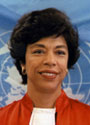
Judge Gabrielle Kirk McDonald (USA)
President of the ICTY from 1997 to 1999
Born: 1942, St. Paul, Minnesota, USA
Judge Gabrielle Kirk McDonald of the United States was among the first eleven judges elected to the ICTY in 1993, and she presided over the Tribunal’s first trial in the Tadić case. In November 1997, she was elected President of the ICTY, a position she held until her departure from the Tribunal in 1999. During her tenure, she fought hard to improve the visibility of the ICTY, including in the region of the former Yugoslavia, by setting up the Tribunal’s Outreach Programme.
Raised in New York and New Jersey, she attended Boston University and Hunter College, and in 1966 she graduated first in her class at Howard University School of Law in Washington, D.C.
After her graduation, she went to work on civil rights cases for Legal Defense and Educational Fund of the National Association for the Advancement of Colored People, where she helped win the organisation's first major job discrimination case. In 1969, she set up a law firm in Houston, Texas with her then husband, and specialised in employment discrimination cases against major corporations and labor unions. She also taught law at the same time.
In 1979, Judge McDonald was nominated to serve on the U.S. District Court for the Southern District of Texas, as only the third African American woman to be appointed to the federal judiciary in the United States. In one of several high profile cases, despite death threats to herself and her family, she ruled in favor of Vietnamese fishermen who had sued the Ku Klux Klan for harassment and intimidation.
She resigned from the court in 1988 to resume private practice and the teaching of law.
Judge McDonald has received numerous awards, including the First Equal Justice Award from the National Bar Association, a nomination as Distinguished Alumni by Howard University, Ronald Brown International Law Award from the National Bar Association, election to the Texas Women’s Hall of Fame and the Horatio Alger Association of Distinguished Americans Award. Today she serves as a judge/arbitrator on the Iran-United States Claims Tribunal in The Hague.
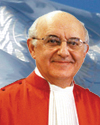
Judge Antonio Cassese (Italy)
President of the ICTY from 1993 to 1997
Born: 1937, Atripalda, Italy
Judge Antonio Cassese was the Tribunal’s first President, holding the position between 1993 and 1997. In those uncharted early years he was one of the key persons who won the necessary political and financial support for the Tribunal and turned it from a court on paper to a functioning international judicial institution. After his tenure as President, Judge Cassese continued to sit as a Tribunal judge until February 2000. He participated in all the landmark judgements and decision rendered by the Appeals Chamber during his time at the ICTY.
Professor of International Law at the University of Florence since 1975, Judge Cassese has published extensively on issues of international human rights and international criminal law. He is the author of International Law and International Criminal Law published by the Oxford University Press, the co-founder and co-editor of the European Journal of International Law, and founder and editor-in-chief of the Journal of International Criminal Justice.
Judge Cassese has been granted Doctorates honoris causa by the Erasmus University at Rotterdam, Paris X University and the University of Geneva, and is a member of the Institut de Droit International. In 2002, he received the Grand Prix awarded by the Académie Universelle des Cultures, presided over by the Nobel Laureate Elie Wiesel, for "exceptional contribution to the protection of human rights in Europe and the world".
He was President of the European Committee for the Prevention of Torture (1989-1993) and Chairman of the Council of Europe Steering Committee for Human Rights (1987-1988). He has represented the Italian Government on many occasions at UN meetings on human rights and at the Geneva Diplomatic Conference on the Humanitarian Law of Armed Conflicts (1974-77).
In October 2004, Judge Cassese was appointed by UN Secretary General Kofi Annan to be the Chairperson for the International Commission of Inquiry on Darfur, to investigate reports of violations of international humanitarian law and human rights law. The Commission’s findings and recommendations lead to the first referral of a situation by the UN Security Council to the International Criminal Court.
He was elected President of the Special Tribunal for Lebanon in March 2009. He resigned on 9 October 2011, on health grounds. Judge Cassese died on 22 October 2011.